
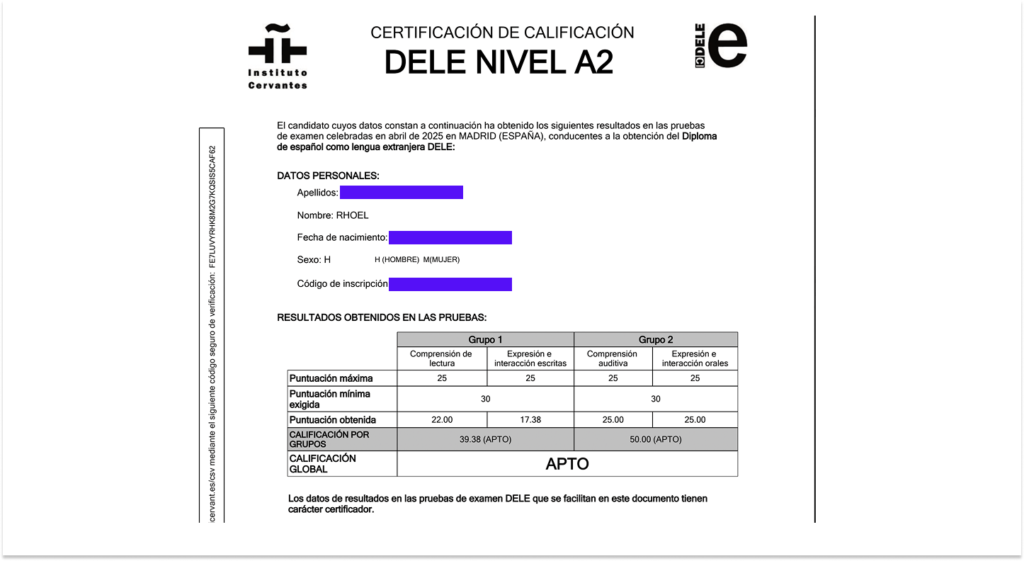
I got my Spanish DELE A2 exam results in April 2025 — and luckily, I passed. I took the test as part of my citizenship application here in Spain. I moved to Madrid back in 2022, and ever since then I’ve made a pact with myself to keep studying Spanish until I reach fluency.
Now, I don’t know your exact reason for reading this article. Maybe you’re planning to take the exam and want to hear from someone who’s already done it. Or maybe you’re trying to gauge your own chances of passing and looking for some practical tips. Either way, I hope my experience can help you.
But let me be transparent. Yes, I’ve been studying Spanish for a while now — but if you think my Spanish must already be really good, the truth is, it’s not. I still struggle a lot. I’d say I understand about 70% of what native speakers say to me, and I often reply in broken Spanish… or sometimes not at all, because I just don’t have the words.
So yes, I was nervous going into the exam — especially for the speaking part. That’s exactly why I want to share my experience with you. In this article, I’ll walk you through what to expect in the DELE A2 exam, how the exam works, my personal study plan, and the tips that helped me prepare. Hopefully, it gives you more insight — and maybe even a little encouragement — if you’re planning to take it too.
What the Spanish DELE A2 Exam Look Like
One thing that really helped calm my nerves before exam day was knowing exactly how the exam was gonna be like. Once you get familiarized with the format of the exam, you don’t waste energy wondering what’s coming next — you just focus on answering, plus you get less anxious.
So, here’s a quick breakdown of the four parts of the DELE A2 exam:
- Reading Comprehension: You’ll read short, everyday texts like ads, emails, or notices and answer questions about them.
- Mode of answering: multiple choices
- Time Provided: 60 minutes
- Total of items: 25 items
- Activity 1 (5 items)
- Activity 2 (8 items)
- Activity 3 (6 items)
- Activity 4 (6 items)
- Listening Comprehension: Here you’ll listen to short recordings — conversations, announcements, or everyday situations — and pick the correct answers.
- Mode of answering: multiple choices
- Time Provided: 40 minutes
- Total of items: 25 items
- Activity 1 (6 items)
- Activity 2 (6 items)
- Activity 3 (6 items)
- Activity 4 (7 items)
- Written Expression and Interaction: You’ll write two short tasks, usually simple texts like an email, a message, or a short description on a familiar topic.
- Mode of answering: written
- Time Provided: 45 minutes
- Total of points: 25 points
- Activity 1: Respond to a short written prompt
- Activity 2: Write a short text
- Oral Expression and Interaction: This is your chance to show you can communicate out loud, even if your Spanish isn’t perfect.
- Mode of answering: oral
- Time Provided: 12 minutes
- Total of points: 25 points
- Activity 1: Describe a photo
- Activity 2: Simulated dialogue
If you don’t already know, Instituto Cervantes not only shares the exam structure, it also provides official sample models of the Spanish DELE A2 exams. These models show you exactly what kind of tasks you’ll need to complete for each activity, in the same format you’ll see on exam day — multiple choice, written tasks, etc.
👉 You can check them out here: under “Examen DELE A2 administrado en 2020”, you’ll find the exact worksheets used in the test. It’s the best way to see for yourself how the exam is gonna be.
Unfortunately, the Cervantes site doesn’t include a sample activity for the Prueba de expresión e interacción orales (the speaking part). But here’s a YouTube video I found really helpful — it shows exactly how the DELE A2 oral exam is carried out, so you’ll know what to expect.
Another Important NoteI also invested in the Curso de preparación para el DELE A2 which I bought from Instituto Cervantes webpage, and honestly, it was a game changer. It’s more than just a review book — it feels like a mock exam. The course comes with tips, strategies to manage your time, and practice materials that mirror the real test. It even includes audios for the listening section.
For me, it was absolutely worth the cost because when exam day came, I didn’t feel lost. I already knew what to expect, and that preparation gave me confidence.
How the DELE A2 Exam Is Scored
The exam is divided into two main groups:- Group 1: Reading comprehension + Writing
- Group 2: Listening comprehension + Speaking
Each group is worth 50 points (so the whole exam = 100 points).
To pass, you need:- At least 30 points in each group
- And 60 points in total
This means you can’t “make up” for a weak section with a strong one — you need to show basic ability across all four skills.
For example:- If you score 32 in Group 1 and 31 in Group 2 = Pass (because both groups are above 30, and total = 63).
- If you score 40 in Group 1 and 20 in Group 2 = Fail (even though the total is 60).
How I Studied For the DELE Exam A2
The first thing I did was check where I actually stood. I took the official sample models of the Spanish DELE A2 exam and gave myself a mini mock test (I gave the links above) — including a photo description and a simulated dialogue. Doing this helped me see my weak spots right away. For me, writing and speaking were definitely the hardest parts, so that’s where I decided to put more focus.
Here are the main resources I used to prepare:
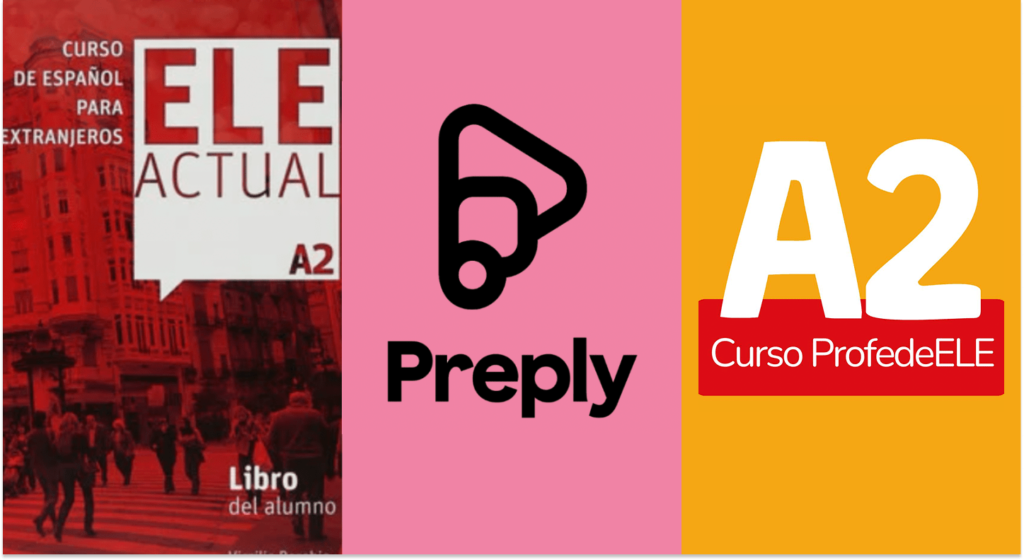
1. Book: ELE ACTUAL A2 – Curso de español para extranjeros (by SM)
This book turned out to be a solid review tool. It comes with a CD, plus a unique code so you can log in online and access the audios from your phone, laptop, or tablet.
What it’s good for:- Reviewing tenses, useful vocabulary, and key topics that are very likely to show up in the DELE A2.
- Strengthening reading and listening comprehension through the practice activities.
2. Online Tutor (Preply)
Since writing and speaking were my weakest skills, I decided to hire an online tutor. I found one on Preply who charged me only €8.50 per 50-minute session. I booked three sessions per week for a month (around €102 total).
What I loved is that she didn’t just meet with me during class — she also gave me extra lessons and practice tasks to work on in between. That showed me how much she cared about my progress.
Impact on my preparation:- Speaking: She helped me structure my thoughts before answering, and taught me techniques to give longer, more meaningful answers. She also guided me on which vocabulary to focus on so I had a ready “arsenal” of words for the exam.
- Writing: She showed me how to tackle each question step by step, and how to express ideas in a way examiners expect from an A2 learner. Honestly, she was one of the biggest factors in boosting my confidence.
3. Free Online Resource (the hidden gem!)
This one almost felt illegal to discover — but the best part is, it’s 100% free. Here´s a website that offers DELE model exams for all four parts (speaking, writing, listening, and reading).
Why it’s amazing:- You can test yourself and see exactly where you stand.
- You can choose what you want to work on — grammar, vocabulary, or specific skills.
- You can even pick your level, from A1 to C2.
For me, this was a goldmine. It gave me endless activities, readings, and practice tests, all without spending a single euro. It really helped me sharpen the areas I wanted to improve the most before exam day.
My 2-Month Study Plan for the DELE A2
- January: Reading and Listening
- February: Writing and Speaking
I did it this way so I wouldn’t have to cram all four skills every day. Focusing on two skills at a time gave me more space to actually improve instead of spreading myself too thin.
January: Reading and Listening For reading and listening practice, I mainly used: ELE ACTUAL A2 textbook & The free online resource I mentioned earlier (full of activities and mock tests). Here´s how my January schedule looked like:- Weekdays: 1 hour reading + 1 hour listening
- Weekends: 2 hours reading + 2 hours listening
- Weekdays: 1 hour writing + 1 hour speaking
- Weekends: 2 hours writing + 2 hours speaking
And on top of that daily practice, I also booked a total of 12 tutoring sessions (6 for writing and 6 for speaking). These were extra — not included in my two-hour weekday and four-hour weekend study blocks.
Would You Able to Pass the Spanish DELE A2 Exam as a Beginner?
If we go by the CEFR guidelines, here’s the rough math of how many hours you would need to study for the exam:- From A0 to A1: about 80–100 hours
- From A1 to A2: about 180–200 hours
That’s roughly 300 hours in total.
If you want to reach A2 in one year, the math looks like this: 300 hours ÷ 365 days ≈ 50 minutes a day. On paper, it sounds pretty doable. But real life isn’t always that simple. Your progress depends on many factors:- Do you live around Spanish speakers or only practice online?
- What type of practice are you doing — active speaking/listening, or just passive study?
- Are you using the right resources?
- How consistent are you?
- Does your native language share similarities with Spanish?
- How quickly do you personally pick up languages?
- And yes, even your age can play a role.
My Personal Opinion
This isn’t meant to discourage you from taking the DELE exam if you’re an absolute beginner. I just want to be transparent so you can make a realistic self-assessment and figure out what you need to work on.
Here’s the thing — exams like the DELE are designed to evaluate the level of a language you already have. And language isn’t something you can cram the night before like a history test.
Speaking a language is a skill. A skill that takes time to build through daily exposure, practice, and plenty of trial and error. Passing the A2 exam isn’t about memorizing lists of words or grammar rules — it’s about showing that you can actually use Spanish: to express yourself, understand others, and manage basic reading and writing tasks.
Honestly, you don’t need to be fluent to pass. Most of my friends who did the exam don’t speak Spanish perfectly either. What matters is that you understand the questions and find a way to get your point across — even if you stumble over grammar along the way.
Also, if you’re already good at speaking Spanish, I’d still recommend that you prepare for the exam. Learn how to manage your time so you can finish each task, and most importantly, get familiar with strategies that will help you score more points. DELE tutors from Preply can help you with that.
My Personal Tips If You’re Planning to Take the Spanish DELE A2 Exam
1. Start Early — Don’t Cram
Give yourself enough time to prepare. The first step is to assess your current level. You can use the official DELE sample exams or this FREE DELE sample exams to see where you stand in reading, listening, writing, and speaking.
- If you can confidently pass those practice tests and feel good about your writing and speaking, then 1–2 hours a day for about a month might be enough.
- If not, give yourself more time. The more practice you put in, the lower your anxiety will be on exam day.
2. Practice Real Exam Tasks
Don’t just “study Spanish” in general — focus on A2-level exam tasks. That way, you’ll already be familiar with the topics, tenses, and vocabulary that will come up.
👉 I highly recommend buying the Curso de preparación para el DELE A2 from Instituto Cervantes. It’s basically a reviewer and a mock exam in one. It walks you through the flow of the exam, offers guides and techniques, and even includes audio for the listening section. For me, it was 100% worth it.
3. Listening Tips
During the listening comprehension test, the audios are played twice, and between each item you’re given enough time to think about your answer. Once you’re confident with your choice, use that extra time to read the options for the upcoming question. That way, you’ll already know what details to pay attention to when the audio plays for the next item.
4. Reading Comprehension Tips
If you’re unsure about an answer, skip it and move on. Once you’ve gone through all the items of the entire reading comprehension test, count the questions you’re confident you got right — this gives you a rough idea of your ‘safe points.’ Then, use the remaining time to go back and work on the questions you left unanswered.
5. Speaking Tips
Photo Description
Here’s a simple structure you can follow — something my tutor actually taught me to help construct my answers. With this approach, I never ran out of ideas:
- What is the overall theme? (family in a park, rainy day, busy city, etc.)
- Why do you think so? (what details or things in the photo give you that hint)
- Who do you see? (a man, woman, couple, children — what are they wearing, doing, feeling?)
- When is it happening? (day or night, time — what makes you think that?)
- Where is it happening? (inside a house, outside, in a city, in nature?)
- Finalize: Use closing phrases like “en resumen…” or “en conclusión…” to show you’ve finished.
Simulated Situation
You’ll be asked to choose between everyday topics to simulate. I remember choosing from four options: travel, buying gift, grocery, or leisure activity (but of course these options changes).
- Always pick the topic where you feel you have more vocabulary and ideas.
- Focus on the examiner’s question before forming your answer. If you rush to construct your response without listening properly, it may look like you didn’t understand the question.
- Speak clearly and enunciate — perfect grammar is not required. What matters is that the examiner understands you.
- Be expressive! Use gestures, body language, and even humor if it feels natural. I remember making both the examiner and the observer laugh during my test — and that was definitely a plus.
6. Writing Tips
I got the lowest score from the writing part of the exam, fortunately I still passed but I know I need to improve here. Still, here are the strategies that helped me:
- Stick to the word count. If they ask for 70 words, aim for 70. A word more or less is fine, but don’t go too far off.
- Match the tense of the question. For example, if they ask “¿Qué te gustaría…?” your answer should begin with “Me gustaría…” to show you understood the question and how to use the tenses.
- Pay attention to punctuation and accents:
- Start questions with ¿ and exclamations with ¡
- Capitalize properly
- Don’t forget tildes (é, í, ó, ú) — e.g., comió, educación, más.
- And of course, practice, practice, practice. Over time, you’ll start to figure out how to construct your writing more naturally — especially if you make use of the resources I mentioned above.
- If you don’t have a tutor, another option is to use ChatGPT to review your writing. Even the free version can give surprisingly insightful feedback and offer tips on how to improve.