I arrived in Madrid year 2022, and from that moment, I promised myself I would learn Spanish until the day I reached fluency. Along the way, I’ve tried just about every popular language app out there—Duolingo, Mondly, Rosetta Stone, Pimsleur, SpanishDictionary, and of course, Babbel. Through that experience, I quickly realized that not all apps are created equal. Some had flashy features, some felt fun at first, but only a few actually helped me move forward.
Over time, I learned to notice what really matters in an app: features that actually make learning easier, more practical, and more effective. And that’s why I eventually settled on Babbel. It’s the one app that truly matched what I needed as a language learner here in Spain.
So I wanna share with you my Babbel Review, why it stands out from the rest, and why I honestly recommend it to anyone serious about learning Spanish.
Want to test it out for yourself? Babbel offers a free trial you can check out here.
What Is Babbel?
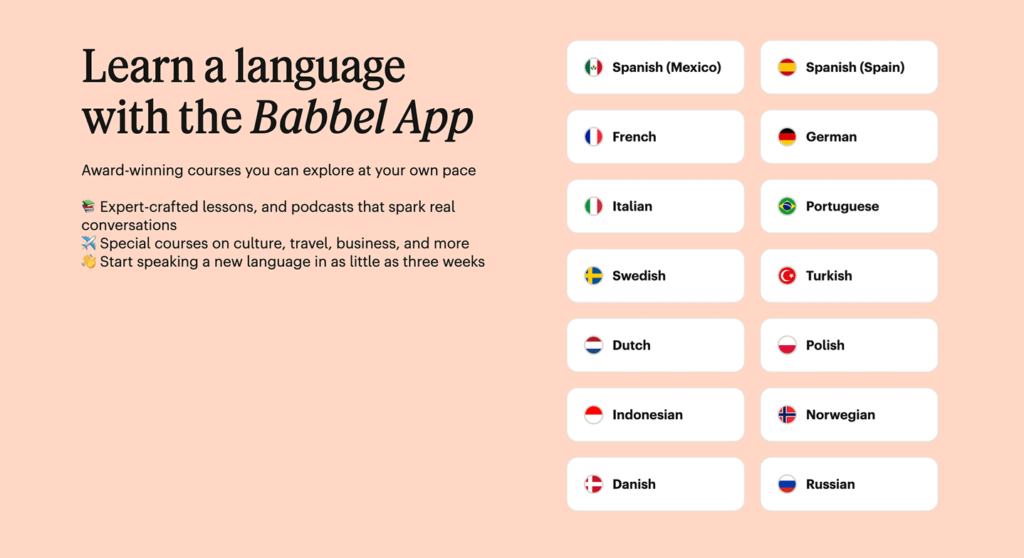
Babbel is a language learning app primarily designed to help you speak and understand a new language through real-life conversations. It’s based on the CEFR (Common European Framework of Reference) framework, so lessons match your level (A1 to C1) and focus on what you actually need to improve. With a mix of grammar, vocabulary, speaking practice, and even live classes, Babbel makes learning practical and manageable with useful skills you can use every day.
As a Spanish learner myself, I’ve learned the hard way that aiming for fluency right away isn’t the best goal when learning a new language. So, if you’re just starting out with Spanish, I highly recommend familiarizing yourself with the CEFR (Common European Framework of Reference). It will guide you on what to focus on at each stage of your learning journey.
Check out this article too to get a clearer idea of what you should learn as a beginner and what’s expected of you along the way.
Quick Rundown: What I Like (and Don’t Like)
- What I Like 👍
- Learning Through Real Conversations
- Guided Progress from A1 to C1
- Smart Review System
- Learning by Listening and Speaking
- Designed for Learners, Not Gamers
- Grammar Without the Overwhelm
- What I Don´t Like 👎
- Too Limited Without a Subscription
- Upfront Payment Feels Pricey
- Voice Recognition Feels Too Lenient
What I Like About Babbel
When I think about why Babbel actually worked for me, it comes down to a handful of things that made my learning feel smoother and more practical. Here’s what I like most about using it.
- Learning Through Real Conversations
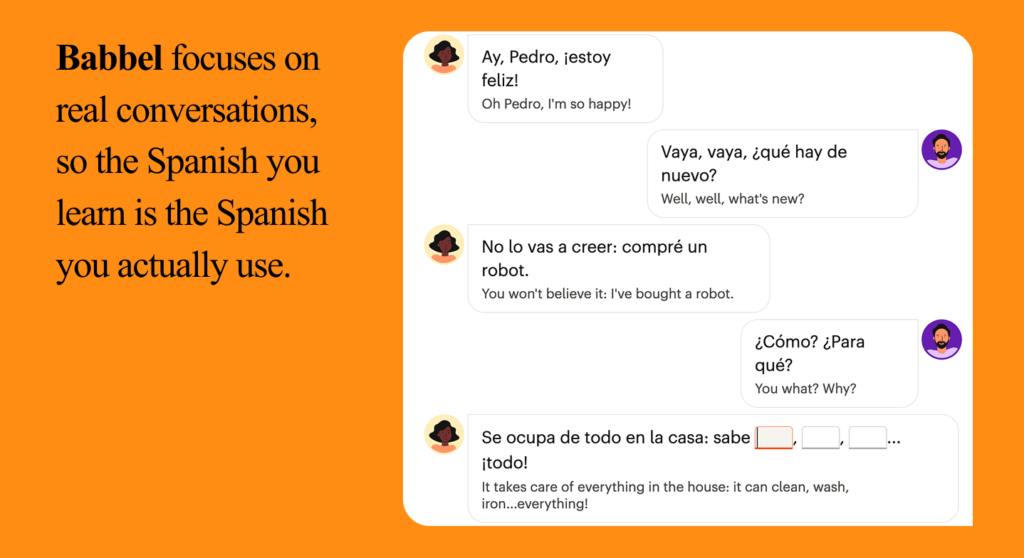
- One of the first things that clicked for me with Babbel was how much it focuses on real conversations. Instead of endless word lists and artificial phrases, it gives you short dialogues—like describing how I feel to a friend, talking about what gifts I want to buy, or greeting someone at work. For me, that’s important because it’s not just random vocabulary. I’m building a toolbox of phrases I can actually pull out when I’m in a real conversation with a Spanish speaker.
- Guided Progress from A1 to C1
- I really like that Babbel follows the CEFR framework (A1 to C1). It makes it clear what I should be learning at each stage. When I was at A2, for example, the lessons focused on daily activities and comparing things—exactly the kind of skills I needed. The difficulty always feels right: not too easy, not overwhelming, just enough to push me forward. On top of that, Babbel has a placement test based on the CEFR, so you can check your level and even retake it later to see how much you’ve improved.
- Smart Review System
- This is probably my favorite part. With other apps, once you finish a lesson, that’s it—you move on, and you never really see it again. Babbel is different. It has a built-in review system that actually reminds you to go back and practice your previous lessons. That way, instead of just cramming new words, I get to strengthen what I’ve already learned and store it in long-term memory.
- Learning by Listening and Speaking
- What I like is how Babbel balances both listening and speaking in every lesson. I’m not just reading words on a screen—I hear how they actually sound, then I get to say them back using the app’s voice recognition. It’s not the same as chatting with my Spanish coworkers, but it gave me a safe space to practice out loud. And honestly, speaking the words—even to an AI—helped me more than just tapping the screen. It trained me to actually use my voice, which made real conversations feel less intimidating.
- Designed for Learners, Not Gamers
- Unlike other apps, Babbel isn’t gamified. Personally, I find all the flashy visuals and sound effects on some apps more distracting than helpful. Babbel’s design is minimalist and clean, which makes it easy to navigate and keeps me focused on actually learning instead of being entertained by the app itself. It feels like Babbel was built for people who take learning seriously—people like me who want progress, not just points or badges.
- Grammar Without the Overwhelm
- For me, learning grammar is basically about recognizing language patterns. Once I see the pattern, it becomes easier and faster to understand what I’m reading or hearing—and it also helps me put together my own phrases when I want to express myself. That’s why I appreciate Babbel’s built-in grammar explanations. Every lesson takes a moment to show why a phrase works the way it does, so I don’t have to keep running to Google, forums, or even ChatGPT to figure it out. A lot of other apps skip this part, but Babbel makes sure grammar is explained in a simple way.
What I Don´t Like About Babbel
While Babbel has been the perfect companion app for my Spanish learning, I also want to be transparent about the areas where it could improve.
- Too Limited Without a Subscription
- With Babbel’s free version, you only get access to the very first lesson or two in each course. To unlock the full range of lessons, review tools, and extra features, you’ll need to subscribe. For me, it wasn’t a dealbreaker because I was serious about learning, but I can see how some people might find it frustrating if they’re expecting a longer trial.
- Upfront Payment Feels Pricey
- I got my Babbel subscription during a sale, which brought it down to about €8.99 per month for six months. Sounds affordable, right? The catch is I had to pay the full six months upfront—so that’s a one-time payment of €53.94. When you think about it monthly, it’s a good deal, but handing over that much at once can feel a bit steep. That’s just my take, though—it’s still a solid investment if you’re serious about learning.
- Voice Recognition Feels Too Lenient
- While I like how Babbel does offer speaking practice, the voice recognition isn’t always spot-on. Sometimes it marks things as correct even when I know I didn’t pronounce them that well. I appreciate that it gives me space to practice my speaking skill, but I kinda wish that it pushed me a bit more or gave more honest feedback.
My Personal Experience: Is Babbel Worth It?
Before moving to Madrid, I had never even heard of the CEFR framework. But once I got here, I noticed something important—when I applied for jobs, they often required a B1 level of Spanish. That was the first time I realized language learning wasn’t just about translating or “learning some words.” There’s actually a global standard for measuring progress.
This is where Babbel made a big difference for me. Other apps felt like they were throwing random lessons at me, but Babbel divided everything into clear levels from A1 to C1. Each lesson showed me exactly what topics and grammar points I needed to cover at that stage. It gave me a sense of direction. I wasn’t just studying aimlessly anymore—I could see that I was moving toward a goal, one CEFR level at a time.
The built-in review feature also became a big part of my routine. Instead of leaving finished lessons behind, Babbel brings them back at the right time so I can practice again. That repetition helps transfer what I’ve learned into long-term memory, which makes a huge difference when I’m trying to actually use Spanish in real life. It feels less like an app and more like a learning assistant guiding me along the way.
But what really sets Babbel apart for me is the way it focuses on communication. The lessons aren’t written like storytelling exercises—they’re dialogues between people, the way conversations actually happen in real life. This is very important to me, because I’m not just learning Spanish to memorize words in a book, I’m learning it so I can connect with people.
I remember one lesson about buying gifts. At first, it felt so simple, but then it hit me—these were the exact kinds of phrases I’d need if I walked into a shop here in Madrid. Another lesson was about describing how you feel, and it made me think about how useful it would be when talking to a friend after a long day at work. And it didn’t stop at “practice.” The next time I was at my job, I actually used one of the greetings from a Babbel dialogue with a coworker: “¿Qué tal tu fin de semana?” to me it was a breakthrough—I wasn’t just studying Spanish anymore, I was living it.
That’s the difference for me. Instead of memorizing random sentences like “the apple is red,” I’m practicing the kind of back-and-forth I’ll actually need in real conversations. Each dialogue feels like another tool I can pull out when I’m face-to-face with a Spanish speaker. And that’s exactly why Babbel has become so important in my Spanish journey.
So, yes! It´s totally worth it.
How Babbel Lessons Work
- Introduction to New Words or Phrases
- Each lesson starts by introducing you to useful vocabulary along with the English translation. These are practical words you’ll actually need in daily conversations.
- Speaking Practice
- Right after learning a new word or phrase, Babbel asks you to say it out loud.
- Multiple-Choice Translation
- Next, you’ll see a few translation options and pick the correct one based on what you were just taught. It’s a quick way to reinforce what you’re learning.
- Fill-in-the-Blank Exercise
- Then you’re asked to complete a sentence by filling in the missing word. This step helps you see how the vocab is used in context.
- Mini Conversations
- At the end, you’ll listen to a short, real-world style dialogue. In this dialogue you will be asked to fill in the blanks with the words you just learned. You can also listen to the whole dialogue afterwards.
Basically, it’s active recall in action. Instead of just reviewing things passively, Babbel keeps making you retrieve and use the vocab. That’s what helps it stick in your memory—because you’re using it, not just seeing it.
Babbel´s Special Features
Babbel isn’t just about going through lessons—it comes with helpful extras that make the whole experience smoother and more effective for someone like me learning on my own.- Review Section
- This is where I go back and practice what I’ve learned so I don’t forget things. It uses spaced repetition (SRS), so it reminds me to review a word or phrase just before I’m about to forget it. I also get to choose how I want to review—speaking, writing, listening, or flashcards—depending on what I feel like doing.
- Vocabulary List
- I can save the words I’ve learned along the way. Babbel keeps them in one place so I can easily go back and review them when I need to. It’s a small feature, but it makes reviewing my vocabularies really accessible.
- Streak Challenge
- There’s a streak tracker that challenges me to stay consistent. For some weird reason, to me completing my streak is important. Seeing those streak numbers unbroken makes me feel productive (lols).
- Podcasts and Audio Lessons
- On days when I’m not in the mood to stare at my screen, I listen to Babbel’s audio lessons or podcasts. They’re great for training my ears, and the pace is beginner-friendly too.
- Guided Conversation and AI Conversation Practice
- There’s a conversation feature that uses AI. It lets me speak with a virtual partner using what I’ve learned. It’s not perfect, but it’s a useful way to get speaking practice without needing a real person around.
Babbel´s Pricing
Babbel often runs promotions—usually between 25% to 50% off, especially around holidays or Black Friday. I grabbed mine with a 25% discount, so it was definitely worth waiting for a sale.
| €35.97 | 3 months |
| €71.94 | 6 months |
| €143.88 | 12 months |
| €599.99 | Lifetime |
Curious if it’ll work for you too? Try Babbel’s free trial and see how it feels.