Welcome to The Spanish Intermediate Plateau Podcast, a European Spanish podcast with transcript.
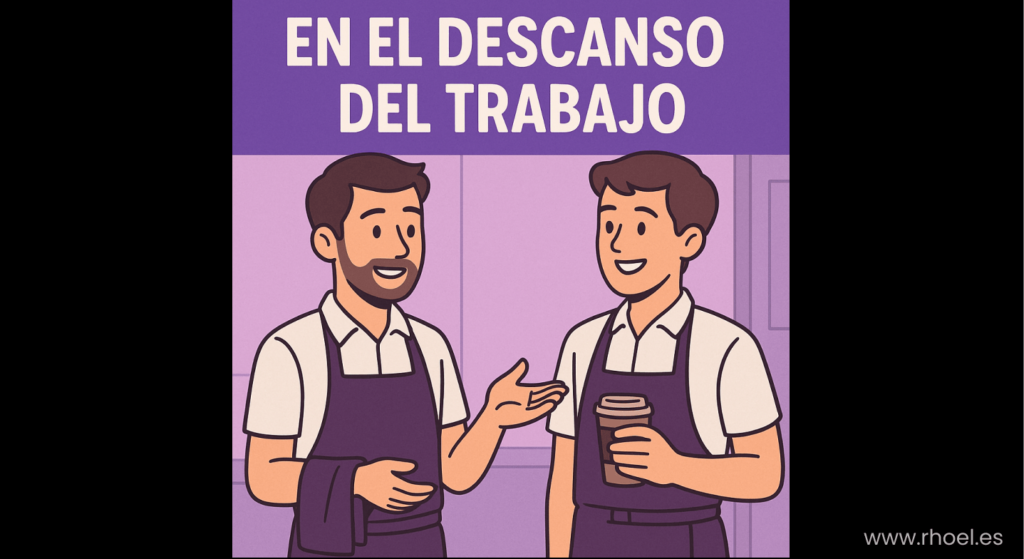
In today’s episode, you’re going to listen to a casual conversation between two waiters in a restaurant during a break. You’ll hear how two people talk in European Spanish about work, routines, gym habits, frustrations with learning Spanish, and everyday things like the heat, living in the city, and getting along with coworkers.
Target Audience: Intermediate Spanish Learners (B1-B2) Grammar Rule Highlights:- Duración de una acción: Llevar + gerundio
- Expresar el inicio o la duración: Desde / desde hace / desde que
- Pedir y dar valoraciones: Parecer / costar / resultar
- Expresar habilidad o dificultad: Ser bueno / malo en or para / me cuesta / se me da bien
- Talking about personal experiences
- Evaluating work-related situations
- Expressing difficulty, effort, and progress
- Express emotions (surprise, empathy, support)
Want to study this conversation further?
Download the transcript here: [Download Script – Google Doc]
Or listen to the full audio on YouTube: [Listen on YouTube]
Alright, let’s jump into the conversation.
European Spanish Podcast with Transcript
Script
Carlos:
Por fin un poco de calma. El servicio hoy ha sido una locura.
Finally, a bit of calm. Today’s service was crazy.
Edu:
Ya te digo. No he parado desde que abrimos. Llevo currando aquí tres años y todavía me agobia cuando se llena así.
Tell me about it. I haven’t stopped since we opened. I’ve been working here three years and it still stresses me out when it gets this busy.
Carlos:
¿Tres años ya? Cómo pasa el tiempo. ¿Y qué tal, te sigue gustando el curro?
Three years already? Time flies. So, do you still like the job?
Edu:
Sí, la verdad es que sí. Este restaurante me mola. El ritmo es duro, pero me siento cómodo. Con el equipo que tenemos se trabaja a gusto.
Yeah, honestly I do. I like this restaurant. The pace is tough, but I feel comfortable. With the team that we have, it’s nice to work here.
Carlos:
Totalmente. La gente aquí se lleva bien. ¿Sigues yendo al gimnasio después del trabajo?
Totally. Everyone gets along here. Do you still go to the gym after work?
Edu:
Claro. Es parte de mi rutina ya. Llevo yendo unos tres años. Aún no me he puesto en forma del todo, pero me gusta. Me deja la cabeza tranquila.
Of course. It’s part of my routine now. I’ve been going for about three years now. I’m not completely in shape yet, but I like it. It clears my head.
Carlos:
Yo lo intenté una vez y duré dos semanas. Soy malísimo para mantener hábitos.
I tried once and lasted two weeks. I’m terrible at keeping habits.
Edu:
Al principio a mí también me costaba un montón, pero ahora lo encuentro muy útil para desconectar del trabajo.
At first, it was really hard for me too, but now I find it very useful to disconnect from work.
Carlos:
¿Y qué haces en el gym?
So what do you do at the gym?
Edu:
Un poco de todo. Pesas, algo de cardio, y estiramientos. No busco estar fuerte, solo cuidarme.
A bit of everything. Weights, some cardio, and stretching. I’m not trying to get huge, just to take care of myself.
Eso está bien. Con todo el trabajo que hacemos aquí, un poco de equilibrio viene bien.
That’s good. With all the work we do here, a bit of balance helps.
Edu:
Exacto. Y el gimnasio me da estructura. Aunque esté cansado, sé que cuando salgo me siento mejor.
Exactly. And the gym gives me structure. Even if I’m tired, I know that when I leave I feel better.
Carlos:
Eso es disciplina, tío… Por cierto, ¿cuánto tiempo llevas viviendo en Madrid?
That’s discipline, man… By the way, how long have you been living in Madrid?
Edu:
Ya llevo un par de años aquí, desde 2022. Me encanta la ciudad. Tiene de todo. Aunque el verano lo encuentro insoportable.
I’ve been here a couple of years, since 2022. I love the city. It has everything. Though I find the summer unbearable.
Carlos:
Tienes razon. El calor madrileño no tiene perdón. Pero el otoño compensa.
Your right. Madrid heat is unforgiving. But autumn makes up for it.
Edu:
Sí, el otoño aquí es perfecto. Además, vivir en Madrid me ha ayudado a mejorar mi español poco a poco.
Yeah, autumn here is perfect. And living in Madrid has helped me improve my Spanish little by little.
Carlos:
Lo hablas bastante bien, la verdad.
You actually speak it pretty well, honestly.
Gracias, pero todavía me cuesta expresarme con naturalidad. A veces se me atascan las palabras o se me olvida cómo decir las cosas.
Thanks, but I still find it hard to express myself naturally. Sometimes I get stuck on words or forget how to say things.
Carlos:
Eso nos pasa a todos. Pero se te da bien aprender, tío.
That happens to all of us. But you’re good at learning, man.
Edu:
Lo intento. Soy bueno para entender cuando la gente habla, pero me cuesta hablar rápido.
I try. I’m good at understanding when people talk, but I struggle to speak fast.
Carlos:
Tranquilo. Con el tiempo todo llega. Llevas cuatro años estudiando, ¿no?
Don’t worry. Everything comes with time. You’ve been studying four years, right?
Edu:
Sí, por mi cuenta, desde 2021. Al principio lo encontraba fácil, pero ahora lo encuentro más complicado.
Yeah, on my own, since 2021. At first I found it easy, but now I find it more complicated.
Carlos:
Normal. Cuanto más avanzas, más matices tiene el idioma. Lo importante es seguir dándole caña.
Normal. The more you progress, the more details the language has. The important thing is to keep pushing yourself.
Edu:
A veces me da rabia, pero pienso que hace unos años no entendía nada y ahora puedo mantener una conversación.
Sometimes it annoys me, but then I think that a few years ago I didn’t understand anything and now I can hold a conversation.
Carlos:
Y además, currando aquí practicas cada día sin darte cuenta.
And besides, working here you practice every day without even realizing it.
Edu:
Sí, eso ayuda un montón. Entre los clientes y vosotros aprendo más que en cualquier libro.
Yeah, that helps a lot. Between the customers and you guys, I learn more than from any book.
Carlos:
Pues mira, al final este curro sirve de academia también.
See? In the end, this job doubles as a school.
Exactamente. Aprender y cobrar al mismo tiempo, nada mal.
Exactly. Learning and getting paid at the same time—not bad at all.
Carlos:
Eso sí que compensa. Bueno, me voy a por un café antes de la cena. ¿Quieres uno?
That definitely pays off. Anyway, I’m going to grab a coffee before dinner. Want one?
Edu:
Venga, tráeme uno también. Nos espera otra ronda larga.
Sure, bring me one too. Another long round is waiting for us.
Important Note (from one learner to another):
Just a quick reminder before we jump in — everything you’ll see in the grammar rules and vocabulary list comes from my own learning process. These explanations are short on purpose because I’m not trying to teach Spanish formally. I’m simply highlighting the structures I’m practicing myself and the phrases I’m trying to get familiar with.
So please read them with that in mind: if something isn’t fully clear or you need more detail, feel free to look it up and go deeper. I leave these notes here so you can see what I’m focusing on as an intermediate learner, and maybe they’ll help you notice the same things.
Also, keep in mind that many of the words and expressions I include—especially the slang and colloquialisms—can change depending on the context. I pick them up from real conversations with locals here in Madrid, not from textbooks or apps, because those usually stay very formal to sound “academic” or “professional.”
This whole project is just my way of learning and a way to share the process with anyone who feels stuck in the intermediate plateau, as I do. Hope this helps.
Grammar Rules
1. Llevar + Gerundio
Grammar Objective: Express the duration of an action that started in the past and continues in the present. Structure: Llevar + tiempo + gerundio (-ando / -iendo) Meaning: “I’ve been doing X for Y time.” Examples from script:- Llevo currando aquí tres años.
→ I’ve been working here for three years. - Llevo yendo al gimnasio unos tres años.
→ I’ve been going to the gym for about three years. - Llevo viviendo aquí desde 2022.
→ I’ve been living here since 2022.
2. Desde / Desde hace / Desde que
Grammar Objective: Express the starting point of an action that continues. English uses “since” for everything but Spanish has three different ways to express “since” or “for,” depending on what follows.
2.1 Desde + point in time (date, year, moment)- Vivo aquí desde 2022.
→ I’ve lived here since 2022.
- Vivo aquí desde hace dos años.
→ I’ve lived here for two years.
- No he parado desde que abrimos.
→ I haven’t stopped since we opened.
3. Valoraciones: Giving Personal Evaluations
Grammar Objective: Pedir valoración y valorar. Instead of using “es difícil” or “es fácil,” Spanish offers more natural and personal structures. This is a big ELE Actual objective.
lo encuentro difícil / raro / interesante / cómodo / complicado / aburrido… Examples from script:
- Lo encuentro muy útil para desconectar.
→ I find it very useful to disconnect.
me cuesta levantarme, concentrarme, organizarme, decidir… Examples from script:
- Me cuesta expresarme con naturalidad.
- Me cuesta hablar rápido.
me da rabia equivocarme, olvidarme de las palabras… Example from script:
- A veces me da rabia. (implied: not being able to speak as well as I want)
- Soy bueno para entender cuando la gente habla.
- Soy malísimo para mantener hábitos.
- Se te da bien aprender.
Vocabulary Highlights
Useful European Spanish colloquialisms and expressions you’ll hear every day.Example:
- Ya te digo. → “For real.”
- Hace calor hoy. → “It’s hot today.”
Explanation: Used for situations that make you anxious, pressured, or uncomfortable.
Example:
- Cuando hay mucha gente, me agobia. → “When there are too many people, it overwhelms me.”
Explanation: A super informal way to say work instead of trabajar. Most commonly used in Spain.
Example:
- Mañana tengo curro. → “I have work tomorrow.”
- Hoy hemos currado mucho. → “We worked a lot today.”
Explanation: Casual and youthful, used constantly in Spain.
Example:
- Esta canción me mola.
- → “I love this song.”
Explanation: Spanish often expresses general experiences using the impersonal se. Instead of saying “I work comfortably here”, Spaniards say:
- Con este equipo, se trabaja a gusto. → “With this team, it’s pleasant to work.”
- Spanish say it as “One eats well here.”
- English meaning: “The food is good here.”
- Spanish say it as “One lives very well in this city.”
- English meaning: “People live well in this city.” or “Life here is great.”
- Spanish say it as “With a good atmosphere, one learns better.”
- English meaning: “With a good atmosphere, people learn better.”
Explanation: Llevarse bien is a reflexive verb (llevarse). It focuses on how two people relate to each other, NOT on “liking” someone. This is why in Spain you hear it everywhere.
Example:
- Ella se lleva muy bien con su jefe. → “She gets along really well with her boss.”
- ¿Te llevas bien con tus compañeros? → “Do you get along with your coworkers?”
- Aquí la gente se lleva bien. → “People here get along well.”
Explanation: Very common intensifier.
Example:
- Te ayuda un montón. → “It helps you a lot.”
Explanation: Spanish uses a special pattern (accidental reflexive se) to say that something happens them involuntarily: Se + me/te/le/nos/os/les + verb. And this is a big cultural-linguistic difference (a huge scratch in the head). In English, the subject is YOU, But in Spanish, the subject is often THE THING: Example:
- A veces se me atascan las palabras cuando hablo rápido. → “Sometimes I can’t get the words out when I speak fast.”
- English meaning: “It slipped my mind.”
- Spanish say it as: It forgot itself on me.
- English meaning: “It fell.”
- Spanish say it as: It fell on me.
- English meaning: “It broke.”
- Spanish say it as: It broke on me.
- English meaning: “I forgot the word.”
- Spanish say it as: The word went away from me.
- English meaning: “It passed me by.”
- Spanish say it as: It passed by me.
Example:
- Cuanto más avanzas, más matices tiene el idioma. → “The more you advance, the more nuances the language has.”
Explanation: This expression is very Spanish and full of energy. It means you’re putting in effort, intensity, momentum.
Example:
- Lo importante es seguir dándole caña. → “The important thing is to keep pushing yourself.”
Explanation: Multi-use word. Venga is one of the MOST flexible, common everyday words in Spain. Its meaning changes with tone, similar to English “come on” or “okay.”
It can mean:
- let’s move / let’s go (motivation)
- okay, fine (agreement)
- hurry up (impatience)
- alright then (closing a conversation)
- alright, do it (permission)
Explanation: Very common in Spain. Other Spanish-speaking countries say “ir por.” Spain says “ir a por.”
Example:
- Voy a por un café.
- → “I’m going to get a coffee.”